
Northern Cardinals Are on the Move
Categories: Advocacy; Research
Written by Olivia Maillet
Northern Cardinals are well-known feeder birds that have an extensive range. They are year-round residents in eastern and central North America, from southeastern Canada all the way down through U.S.A, Mexico, and even parts of Guatemala and Belize. While the Northern Cardinal is a symbolic bird of the holiday season, often pictured in snow and winter scenery, their range was not always so far north. In the early 1900s, Northern Cardinals would have been considered a rare bird in the northeast, including Ontario! By the 1960s, they were reported to have established a population in the northeast U.S.A, with breeding evidence being recorded further and further north over time.
Now, they are one of the most commonly seen birds in Ontario, especially in open areas, gardens, and at birdfeeders in suburban and urban areas. Range expansions have been noted for some other familiar faces in Ontario – the Red-bellied Woodpecker, the Carolina Wren, and the Tufted Titmouse are all non-migratory species that have experienced similar expansions in the northern parts of their range to that of the Northern Cardinal.
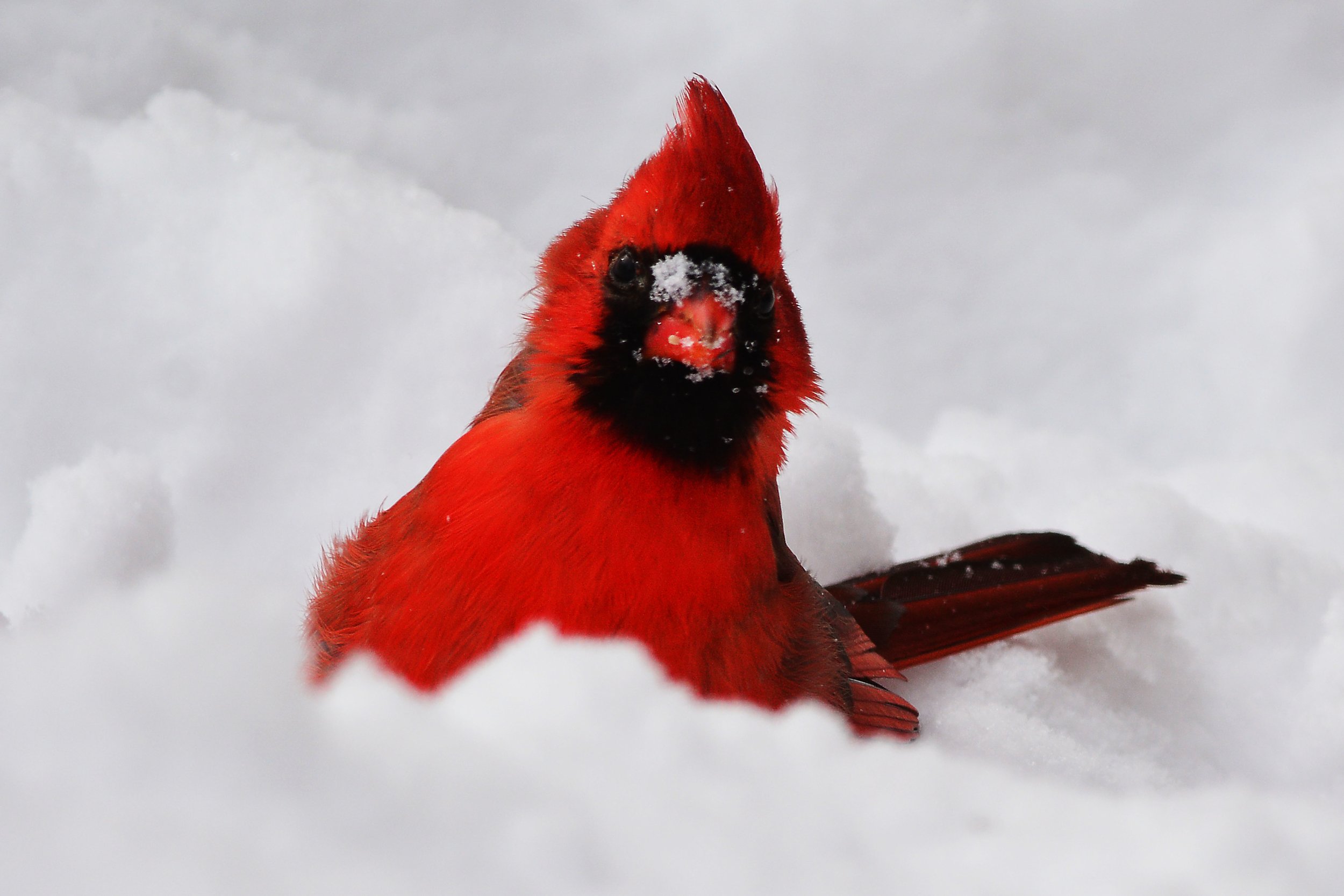
Northern Cardinal (male) in snow. Ian Dickinson
Why range expansions?
There are a few reasons why Northern Cardinals have been able to live year-round and breed further north:
Climate change – Climate change has had major impacts on bird populations and their distributions. Over time, warmer winters in the north have allowed species that are typically excluded by extreme cold temperatures, snow, and limited winter resources to thrive under milder conditions. Northern Cardinals, along with other range-expanding species, are now able to survive winter temperatures further north than before.
Land use change – Northern Cardinal abundance is higher in narrower strips of habitat than broader strips of habitat – likely due to their preference for “edge habitat” and dense vegetation (Peak, R. G., and F. R. Thompson III (2006). Factors affecting avian species richness and density in riparian areas. Journal of Wildlife Management 70(1): 173–179.). These habitat preferences are an excellent match for how land use has changed in Ontario in the last century. Dense, continuous woodlands have been converted into more open lands - agricultural lands, suburbs, hydro corridors, gardens, second-growth forests…all of which are ideal habitats for Northern Cardinals to exploit year-round, foraging during the winter, and for nesting in the spring/summer.
Bird feeders – Bird feeders provide consistent food year-round for species that eat seeds or nuts. Because resource availability in the winter can be a limiting factor for bird survival, it makes sense that seed-eaters would take advantage of this winter buffet! A study in San Antonio, TX, found that bird feeders affect the movements of Northern Cardinals within urban areas. While bird feeders are ubiquitous and difficult to track for researchers to definitively link their use to bird distributions, they likely have played a role in range expansions for a variety of species.
There is still much to learn about factors affecting Northern Cardinal distribution. What biological features allow them to adapt so well to urbanization? How is climate change affecting distribution in the western v.s. the eastern North America? Researchers are even interested in how urbanization could affect their signature red colouration!
What you can do to help cardinals and other birds in the winter
Provide a safe feeding situation – If you choose to feed birds in your yard, make sure you are doing it safely! Consult this guide from Birds Canada to prevent the spread of disease. Northern Cardinals can be susceptible to fatal window collisions. If you are attracting birds to your yard with feeders, it is especially important to make sure that your windows are bird-safe. Find a variety of cheap, easy, and non-permanent methods here. P.S.---cardinals love black oil sunflower seeds!
Winter habitat – Barren lawns and many other non-native plants provide little shelter, cover from predators, and food for winter birds. Providing dense shrubs, evergreens, and fruit-bearing trees can support Northern Cardinals and other wintering birds in your yard. Consider dogwood, sumac, elderberry, serviceberry. Learn more about gardening for birds here.
Participate in citizen science programs – These international and voluntary programs make up a large part of the data that researchers use to measure and track changes in the abundance and distribution of birds. Participate in Project FeederWatch or simply submit any bird observations to eBird. Both programs come from the Cornell Lab of Ornithology. Combined with other data sources, such as PEPtBO’s contribution to the Canadian Migration Monitoring Network, these programs have resulted in high-impact research on the status of bird populations.