
Migration Monitoring at PEPtBO - more than just Banding
Categories: Research
Written by Andrew Brown
At the Prince Edward Point Bird Observatory, part of our mission is to study, monitor, and report on the migration of birds as they move through Prince Edward County year after year. A large portion of our efforts in achieving this mission goes into banding from 8,000 to over 10,000 birds each year. This requires a herculean effort from our staff and many volunteers, but did you know that our efforts in documenting bird migration extend far beyond banding birds?
Banding birds is an essential technique for capturing a picture of what is moving through Prince Edward Point National Wildlife Area during spring and fall migration. It allows us to take a daily snapshot of the birds (mainly songbirds) that move through the forest where our nets are placed during our 6-hour monitoring period each morning. Many of these birds can be very difficult to study without banding - for example thrushes such as Wood Thrush and Hermit Thrush. These birds are notorious for skulking quietly (when not breeding) deep in the forest understory, often away from prying human eyes.
Despite how useful banding can be, there are still many species of birds present at Prince Edward Point throughout the year that are near impossible for us to catch in our nets for various reasons.
Tens of thousands of ducks are present during much of the year in Lake Ontario just offshore from the banding station, but because they don’t fly through the forest, we never capture any. Similarly, thousands of raptors (vultures, hawks, eagles, and falcons) migrate over the banding station, but we only infrequently capture small species like Sharp-shinned Hawk and Merlin.
Finally, even though we band thousands of songbirds each year, we miss exponentially more than we catch that are moving around and over the station away from our nets, which begs the question, how do we capture an accurate picture of migration each day if we are missing the majority of the birds moving through the area?
The answer to this question is quite simple, we just have to look for birds!
However, it gets slightly more complicated when you consider that we need to make our data comparable to data collected on previous days and previous seasons. To make data comparable to each other over time, we must “standardize” our data collection process. For banding, this means opening nets every day during the migration season for the same amount of time in the same locations (weather and bird safety permitting) and recording our effort so we can calculate birds per net hour (the number of birds caught in each net for each hour they are open).
For recording birds that we don’t band, we have two different metrics that allow us to collect standardized data.
The first is a daily census, where a skilled observer who can identify 95% or more of the expected bird species in Ontario by both sight and sound walks along a set route at the same time each morning and counts numbers of each bird species that they can see and hear. At PEPtBO, we do two daily censuses with slightly different routes, a 30-minute census at dawn right after we open our nets, and a 60-minute census an hour after the first one. These two censuses walk through several different habitats around the observatory, from flooded woodlands to dry scrubland, to lakeshore and more which allows us to record a diverse array of birds present in each habitat. These censuses allow us to count birds flying over the observatory first thing each morning as the “morning flight” occurs, a phenomenon where birds that have been migrating overnight can still be seen in active migration in the early morning hours before they stop to refuel for their next leg of migration.
The second technique for studying birds not captured is to have observers record numbers and species of birds seen near the observatory during banding operations throughout the rest of the morning each day. This process can also be standardized by counting the number of hours each observer was present for (typically the entire 6-hour banding period) such that effort counting birds can be compared between days. Again, this allows us to monitor species unlikely or impossible for us to capture. Like morning census allowing us to observe the morning flight of birds, the daily observations are particularly useful in recording another migratory phenomenon – raptor migration.
On warm days with favorable winds, in late morning and early afternoon raptors take advantage of thermal air currents rising off the earth as it is warmed by the sun to aid them in their migration which allows them to expend less energy to migrate.
If morning flight is an “early bird gets the worm” type of birding only accessible to the most dedicated birders willing to get up at the crack of dawn, then raptor migration is the lazy birder’s cup of tea, where you can get up late and let the birds come to you!
Fortunately, at PEPtBO we have dedicated staff and volunteers that are willing to do it all, and so through banding, morning censuses, and daily observations, we try to capture the most complete picture of migration at Prince Edward Point possible.
To get an idea of the birds that we count during migration outside of our banding program, the graphic below shows the top ten species counted by PEPtBO staff and volunteers in 2025. Some of these we do band (i.e., American Robin, Blue Jay, Cedar Waxwing, Common Grackle, and Red-winged Blackbird), but the rest we do not!
We see amazing flocks of ducks like Long-tailed Duck and Greater Scaup, or huge numbers of gulls like Bonaparte’s Gull as they migrate through Lake Ontario. Most impressively, we counted over 180,000 Double-crested Cormorants in 2025. Despite these species being present in extremely high numbers around PEPtBO, it would not be possible to record these numbers without our census and observation efforts, demonstrating the immense value that these protocols have for recording migration in Prince Edward County.
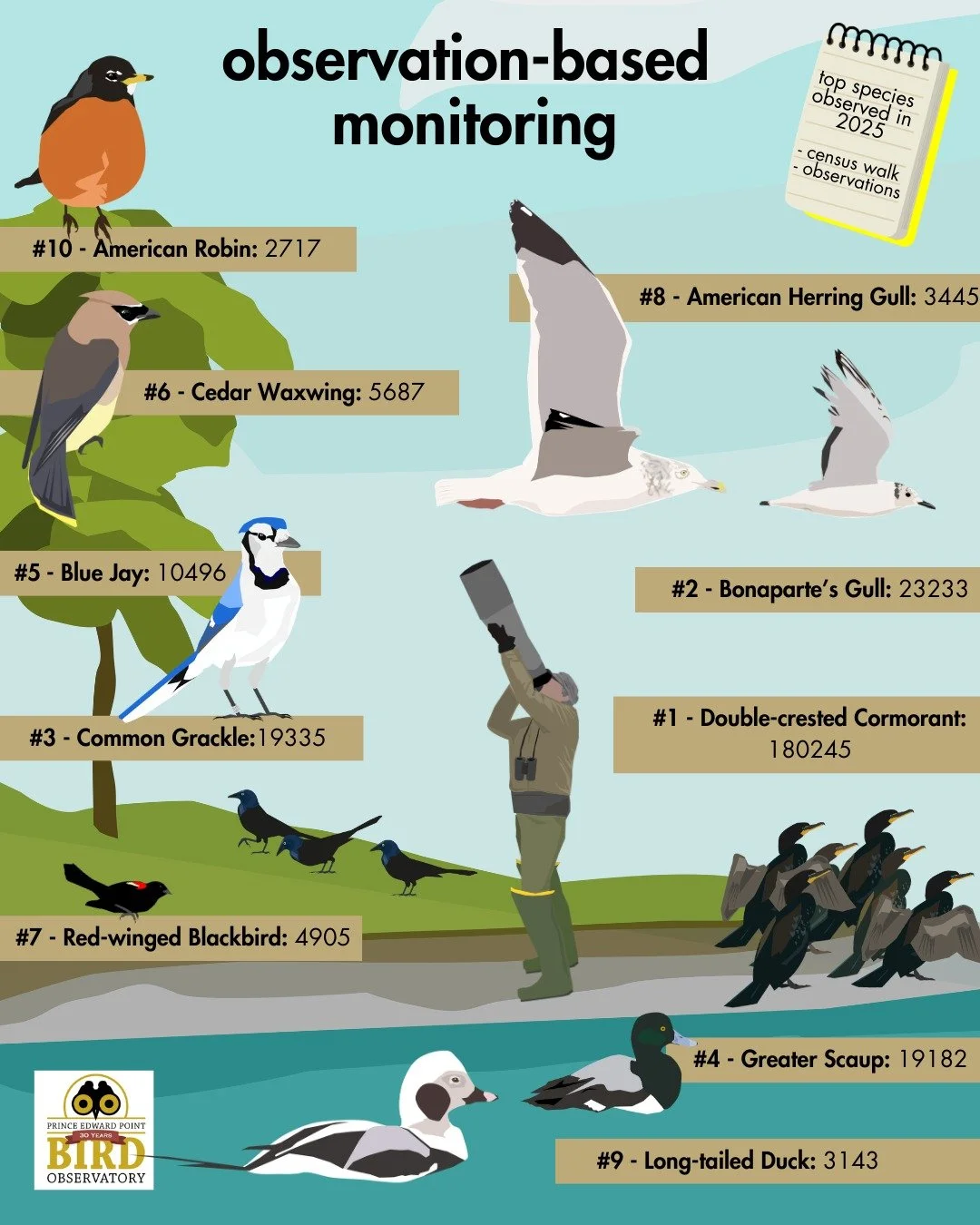
Top Ten Species Counted by PEPtBO Staff and Volunteers in 2025.