
International Connections: The Northern Waterthrush
Categories: Research
Written by Olivia Maillet
In the Western Hemisphere, migratory birds can fly through upwards of 20 countries before reaching their destination. They encounter many different climates, landscapes, and habitats while they migrate and stopover to refuel. Because of observations of birds along their migratory routes, we can piece together parts of their journeys, but we rarely get the opportunity to learn about a bird’s exact movements. We talked to bird researchers in Venezuela to learn more about the movements of one individual migratory bird: A Northern Waterthrush.
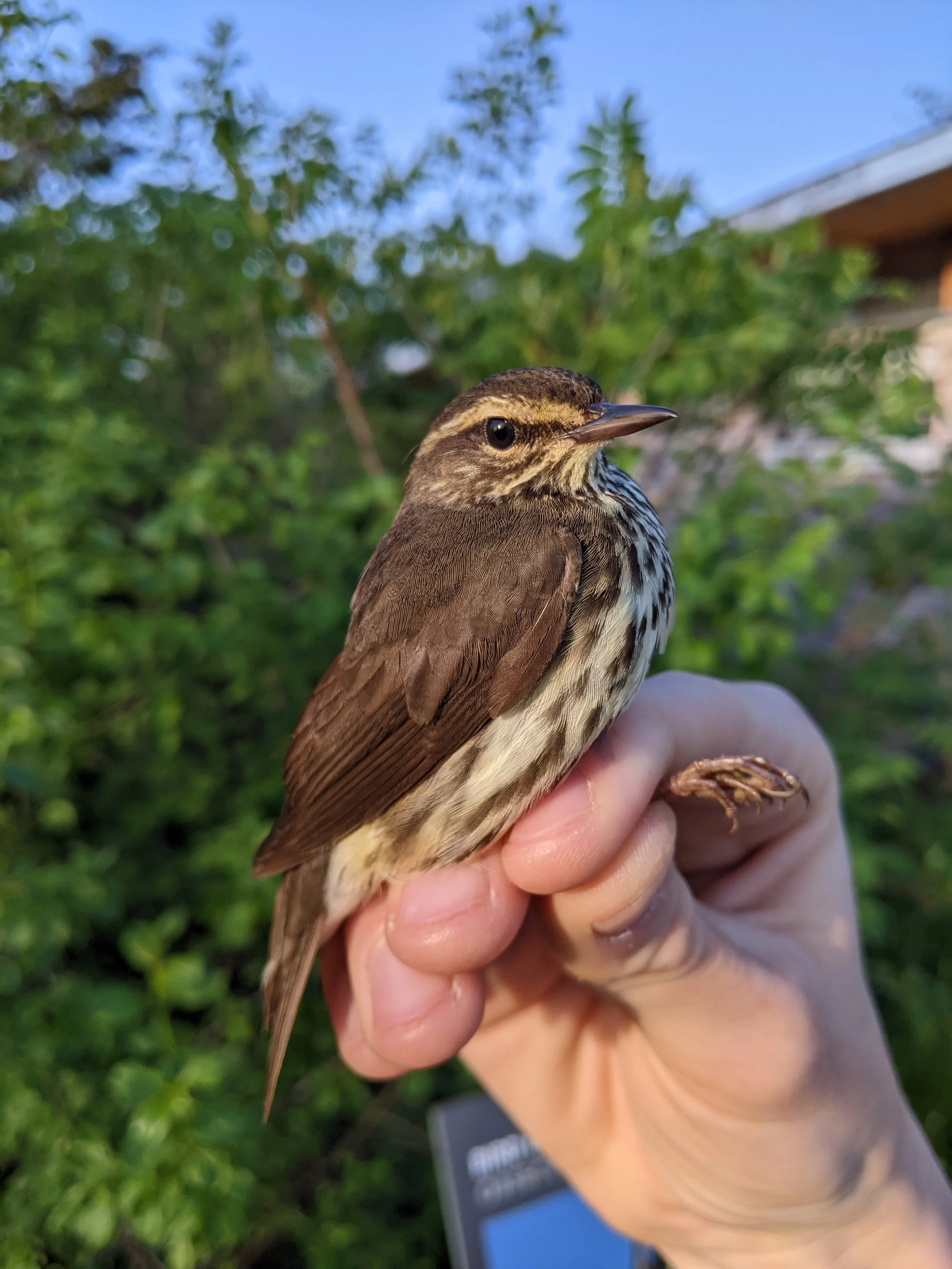
Northern Waterthrush at the lab during spring banding.
The Northern Waterthrush is a long-distance migrant warbler that breeds in Canada and the USA and winters in Central America, the Caribbean, and northern South America. They are common during migration at PEPtBO, and can be found in wetter habitats during the breeding season. When foraging, Northern Waterthrushes walk on the ground or across branches and logs, constantly bobbing their tails as they move through the understory. They are more commonly heard than seen, giving a liquid-y three-part sweet sweet sweet sweet wee wee chew chew chew chew.
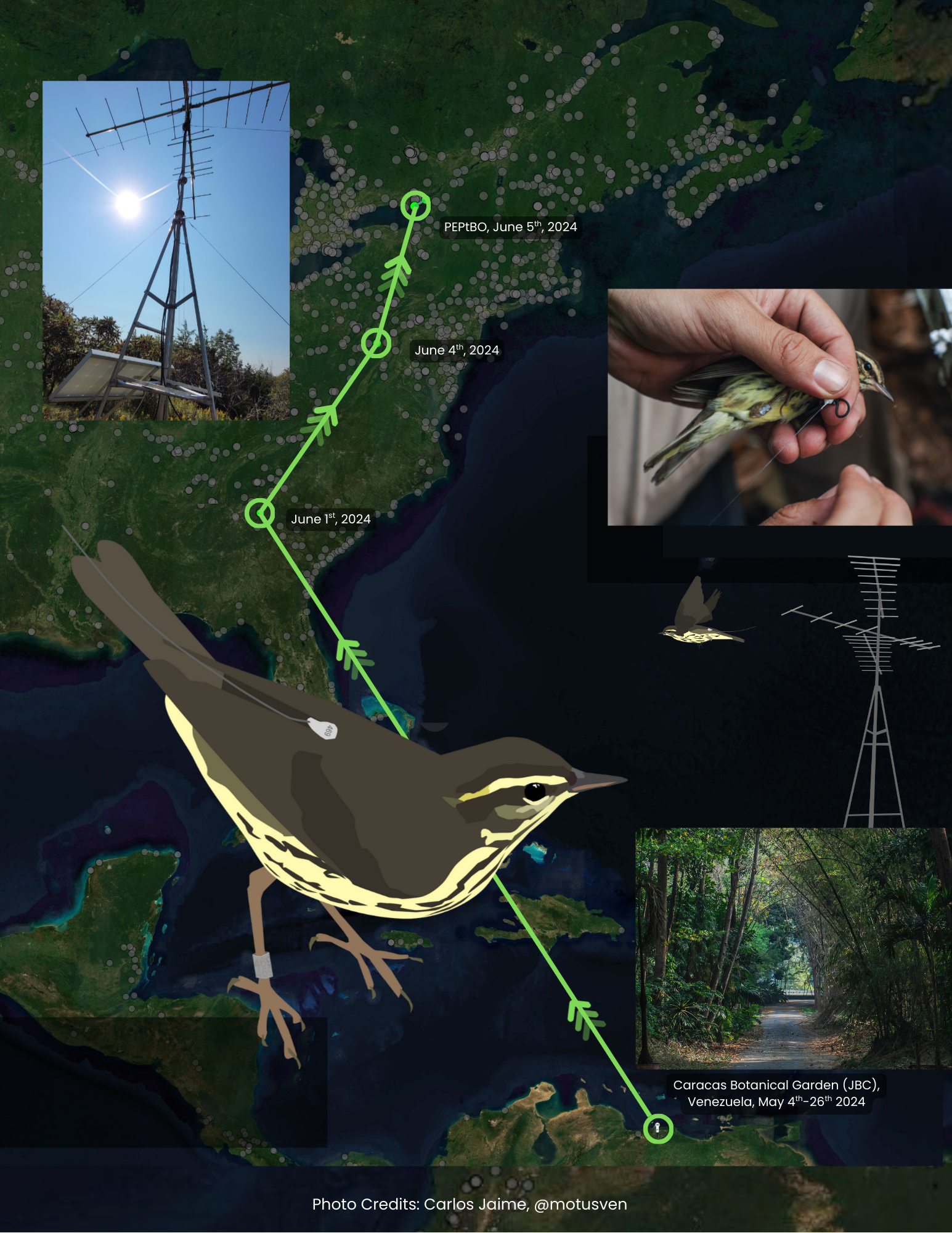
About 4000 km southeast of Prince Edward Point, researchers captured and banded Northern Waterthrushes during spring migration at a park in the center of Caracas - Venezuela’s largest city and capital. These banding efforts are for a targeted research study led by Miguel Matta at the Central University of Venezuela and MOTUSVEN (Motus Venezuela). In addition to a standard metal band, the Northern Waterthrushes received a lightweight radio-transmitting tag to be detected by the Motus Wildlife Tracking System: an international, collaborative network of receiving towers across the Americas and beyond.
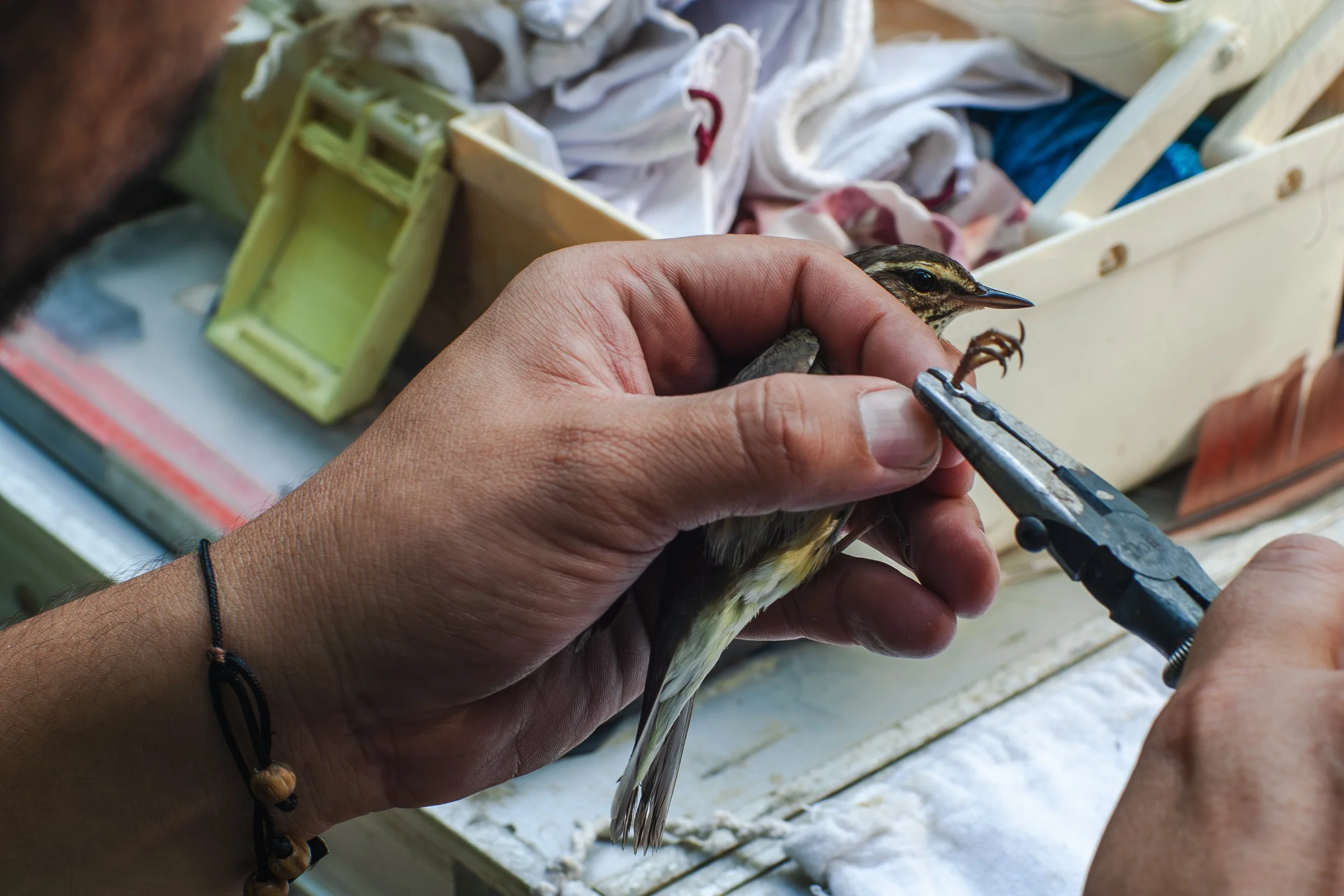
A Northern Waterthrush is banded by researchers. Credit: Carlos Jaime, MOTUSVEN
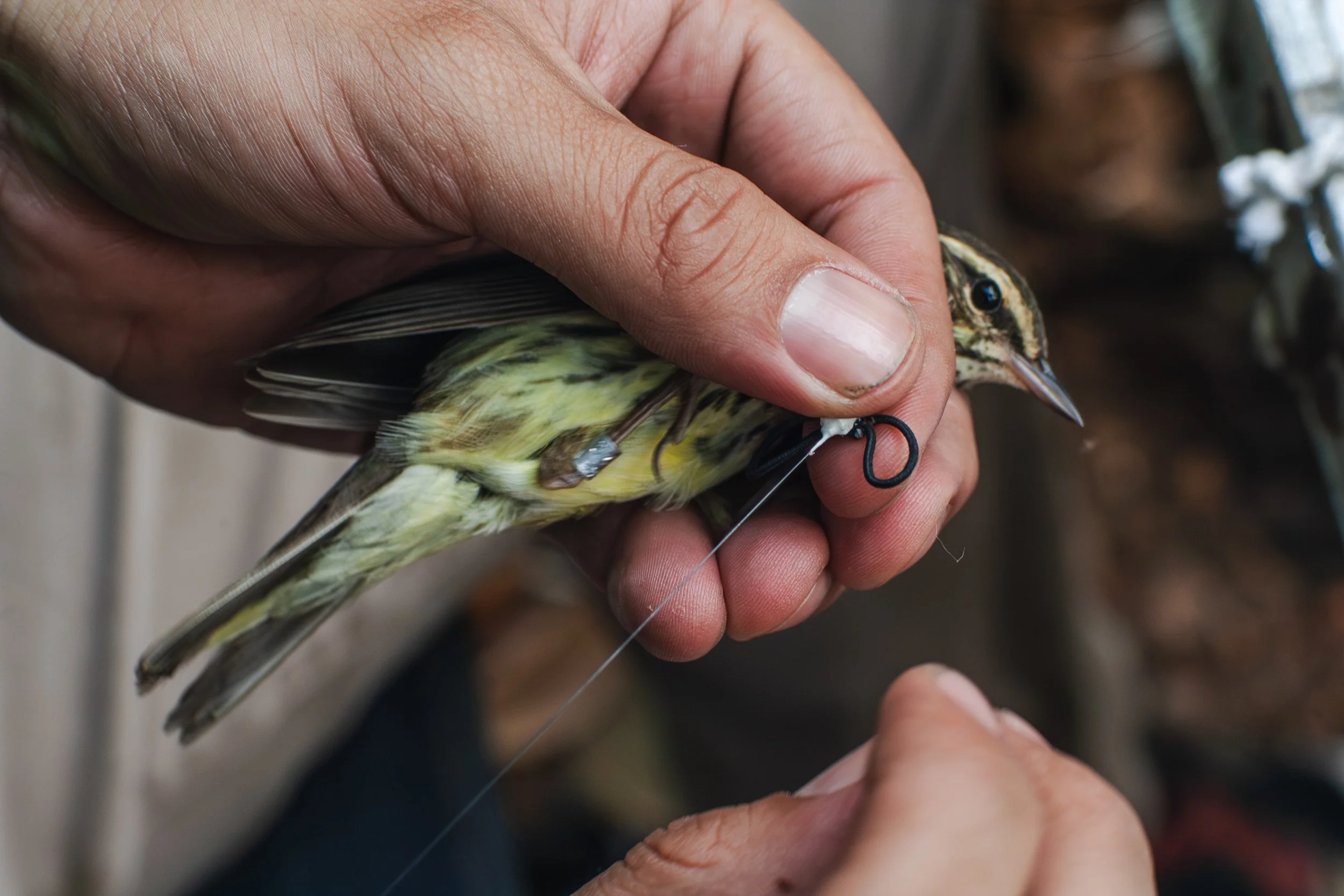
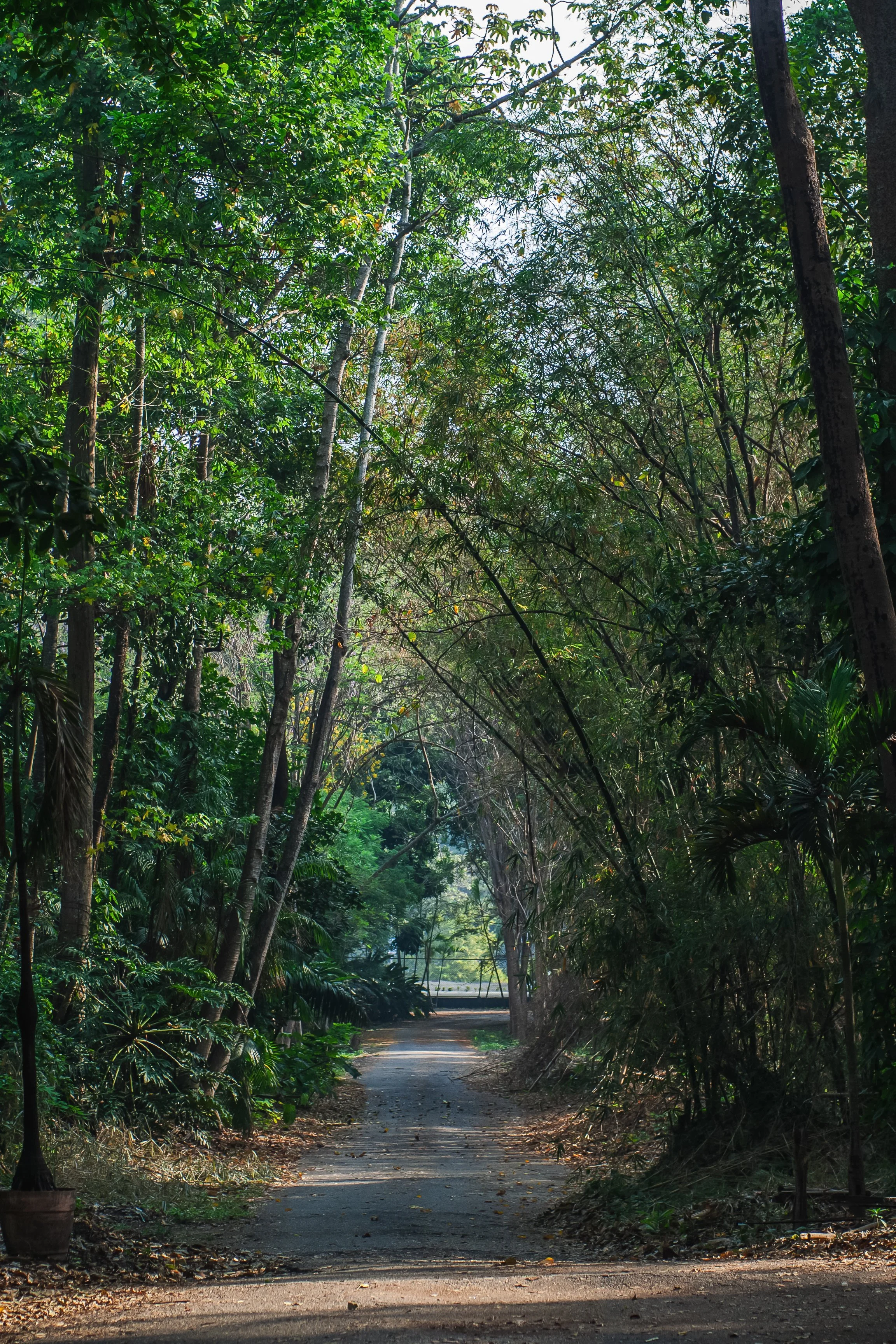
One Northern Waterthrush was flying through the urban park, Jardín botánico de Caracas, when it found itself in a mist net on May 4th, 2024. After a few gentle measurements were taken, a metal band was applied and a lightweight radio-transmitter tag was affixed to its back. Its code was #46669 - this tiny tag automatically emits a unique code to nearby towers. Once promptly released, the Northern Waterthrush was free to continue its day, but now, researchers were able to find out where the bird was going, right from their computers. #46669 remained at the Caracas Botanical Garden until May 26th, 2024.
Photos below: A lightweight radio-transmitter and harness, ready to be placed on the Northern Waterthrush (left).
Caracas Botanical Garden (right). Credit: Carlos Jaime, MOTUSVEN
Less than a week later, the Northern Waterthrush #46669 was detected in Athens, Georgia on June 1st, 2024 for just a couple minutes - no time to waste hanging around! Only a few days later, on June 4th, it was detected flying by a tower in northeastern Maryland, before an apparently near-non-stop flight up to the north shore of Lake Ontario. On June 5th, 2024, #46669 was detected flying by the Motus receiving tower at PEPtBO, right on the south shore of Lake Ontario! It was detected for a few minutes, which means it was quickly passing by on its way to its breeding site. The PEPtBO Motus receiving tower was placed by Birds Canada in 2015 and has detected 20 tagged birds since then.
While we don’t know where this Northern Waterthrush spent the summer, we do know that their breeding range stretches from the northeastern USA, through the boreal forest, all the way up to the subarctic regions of Canada. Their typical breeding habitats include swamps, bogs, thickets along lakeshores, rivers, and streams, where they prefer dense cover and available surface water (Godfrey 1986, Peck and James 1987, Sinclair et al. 2003).
In Ontario, they lay an average of 4 eggs that they incubate over a period of approximately 12 days (Peck and James 1987, Eaton 1957). After the baby Northern Waterthrushes hatch and grow big and strong enough to fledge, they leave the nest and both parents feed the young for about four weeks after fledging (Eaton 1957). Once the adult birds have moulted all of their feathers, and once juveniles are ready to figure out their first long-distance migration, they begin their journey south for the winter.
By mid-October, most individuals are getting back to their wintering grounds. Studies of banded birds showed that individuals return to the same locations in Venezuela in successive years (Schwartz 1964). Unsurprisingly, given the name “waterthrush” in English, and Reinita de los Charcos in Spanish (translating to Queen of Puddles), moisture is a key determinant of their habitat quality (Whitaker and Eaton 2020). When they arrive during the end of the rainy season, they occupy higher slopes, taking advantage of the humidity. However, as November ends and the dry season begins, they descend to humid lowlands (Schwartz 1964). Waterthrushes spend their days in mangroves and wet forests foraging on a variety of prey: small snails, crabs, clams, spiders, beetles, ants, flies, beetles, seeds, and grit (Lefebvre et al. 1992, Whitaker and Eaton 2020)!
Not only is it a special privilege to be able to learn about an individual bird’s movements and life events, but tracking studies provide valuable information that is otherwise unattainable through observation alone. It also reminds us of the incredible feats of migration that many birds undergo each year, defying borders and connecting humans with our shared interest in bird conservation.
Acknowledgments
Motus, a project of Birds Canada
Motus Venezuela (@motusven on Instagram)
Photos by Carlos Jaime and Motus Venezuela
Information from Miguel Matta
BirdLife International (2021) Distribution map for Northern Waterthrush Parkesia noveboracensis. In BirdLife International and Handbook of the Birds of the World (2021) Bird species distribution maps of the world. Version 2021.1
Whitaker, D. M. and S. W. Eaton (2020). Northern Waterthrush (Parkesia noveboracensis), version 1.0. In Birds of the World (A. F. Poole, Editor). Cornell Lab of Ornithology, Ithaca, NY, USA. https://doi-org.proxy1.lib.trentu.ca/10.2173/bow.norwat.01
Peck, G. K., and R. D. James (1987). Breeding Birds of Ontario: Nidiology and Distribution. Volume 2: Passerines. Miscellaneous Publications of the Royal Ontario Museum, Toronto, Canada.
Eaton, S. W. (1957). A life history study of Seiurus noveboracensis (With notes on Seiurus aurocapillus and the species of Seiurus compared). Sci Stud St Bonaventure Univ 19:7-36.
Godfrey, W. E. (1986). The Birds of Canada. Revised Edition. National Museums of Canada, Ottawa, ON, Canada.
Sinclair, P. H., W. A. Nixon, C. D. Eckert, and N. L. Hughes (Editors) (2003). Birds of the Yukon Territory. UBC Press, Vancouver, Canada.
Lefebvre, G., B. Poulin and R. McNeil. (1992). Abundance, feeding behaviour, and body condition of nearctic warblers wintering in Venezuelan mangroves. Wilson Bulletin 104:400-412.