
Categories: Research
Written by Sarah Sharp
The bird known as the Traill's Flycatcher is actually two species of tyrant flycatcher, in the genus Empidonax (coliqually nicknamed the “empid” flycatchers). The species, - identified in the 1970s - are known as the Alder and Willow Flycatchers.
The Willow Flycatcher has a large breeding range from the east to the west coast in the United States. In Canada, they are found only in the southern portion around lakes Erie and Ontario. The breeding grounds of the Alder Flycatcher are much more northern, stretching from coast to coast and right into Alaska and Labrador. Prince Edward Point Bird Observatory is situated in the overlap of both breeding areas.
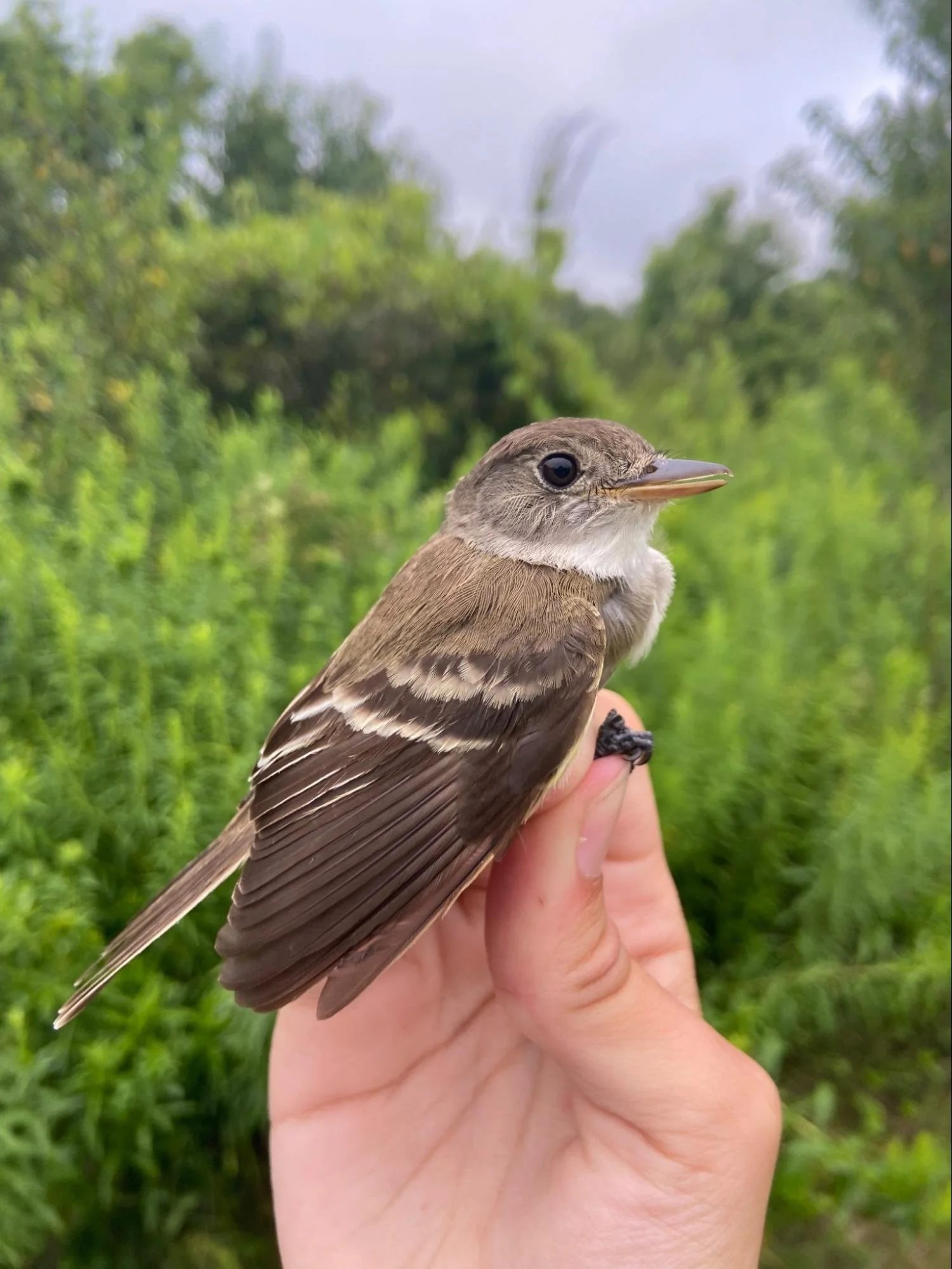
A Traill’s Flycatcher - either Alder or Willow, further measurements were not taken on this particular day for this bird from southern Quebec.
As their names suggest, Willow Flycatchers tend to prefer more open areas with willow shrubs and trees, while Alder Flycatchers prefer more mature forest with many alder thickets. During migration they will use whatever habitat they can find.
The one thing that does clearly separate them apart is their song. Although both of these empid flycatchers have short, whistled songs that are repeated many times from a preferred perch, they have distinct tonal and note differences. The Alder Flycatcher has a slightly buzzier song that sounds like “free beer”. In contrast, the Willow Flycatcher has a sweeter song that sounds like “fitz-bew”. Without hearing their vocalizations, it is difficult to tell them apart as they are visually very similar.
Through careful study of bird specimens, researchers found that detailed measurements of wing morphology (structure) can often help to distinguish between the two species. This requires the banders to take measurements of particular wing feathers. Using these measurements, a formula is applied to determine whether the bird can be assigned WIFL or ALFL. For the most part, these measurements are done on the primary feathers, or the outer flight feathers of the bird’s wing. The measurements are as follows:
Longest primary to the 6th primary
The difference between the 10th primary and the 5th primary
The difference between the 9th primary and the 5th primary
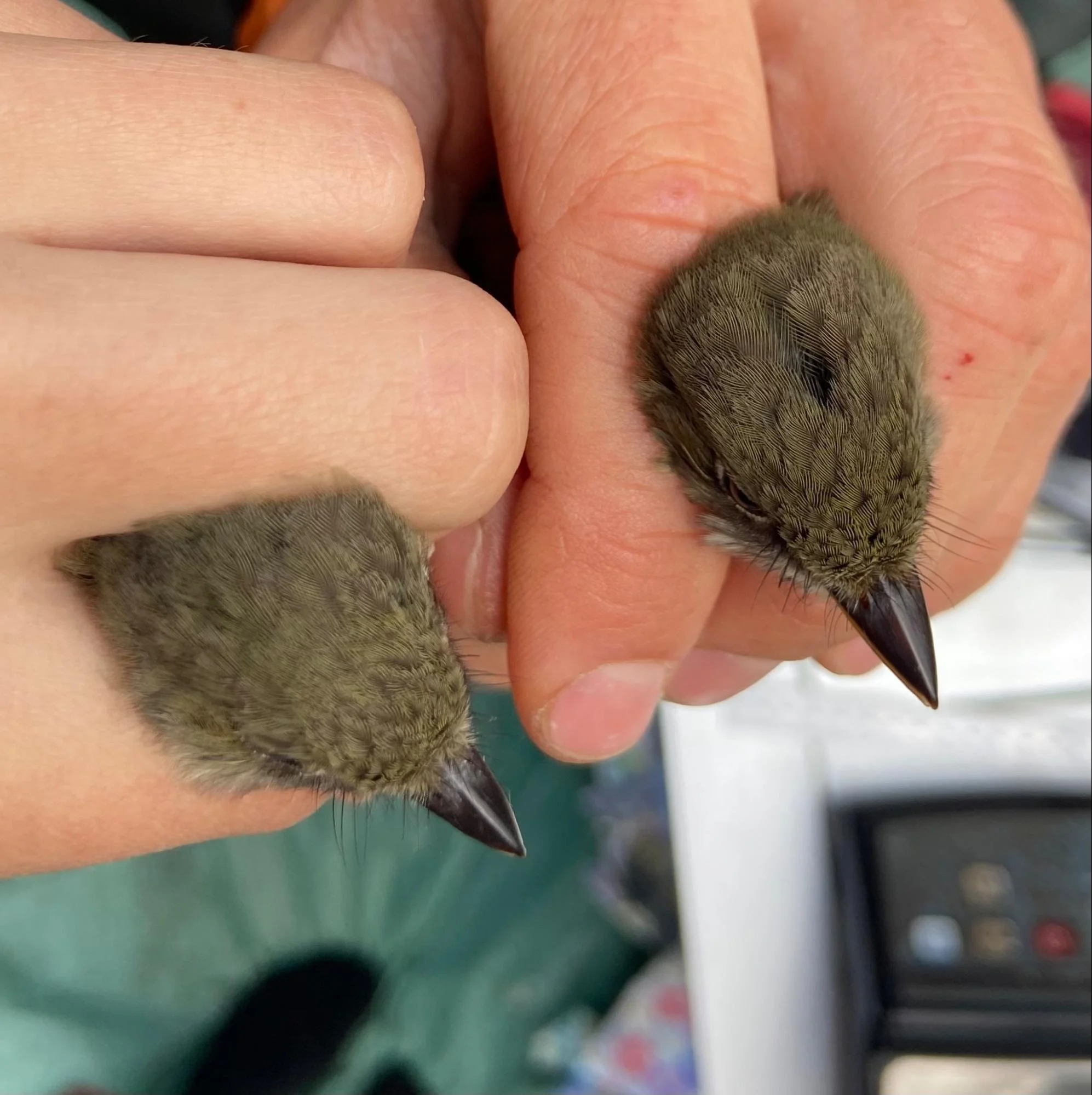
Difference in bill size between Least (left) and Alder (right) Flycatchers. This is taken in the boreal forest of Alberta where Willow Flycatchers don’t occur.
During spring migration, it is not always possible for the banders to take these specific measurements and perform the calculations but without these measurements the bird cannot be 100% identified as either WIFL or ALFL. As a result, banding stations located in the area where their breeding ranges overlap, band both species as “Traill’s Flycatcher” or TRFL.
Traill’s Flycatchers can also look extremely similar to other species of empid flycatchers so measurements are key to identification. For example, there is: wing length and tail length (which can be different between males and females), bill to nares (tip of bill to nostrils), and even measurements between certain feathers.
The book used by all banders for aging and sexing North American bird species is referred to as “Pyle,” after its author Peter Pyle. If you were to look up Traill’s Flycatcher in Pyle, it would show the measurement chart for flycatchers and the formula for separating TRFLs. Banders spend considerable time studying this page with a bird in hand, carefully taking the measurements needed for identification. Even with those measurements, sometimes the most accurate identification possible is simply Traill’s Flycatcher. HINT: this is a perfectly acceptable thing to do while birding as well, and there is even a “Traill’s Flycatcher” listed in eBird.